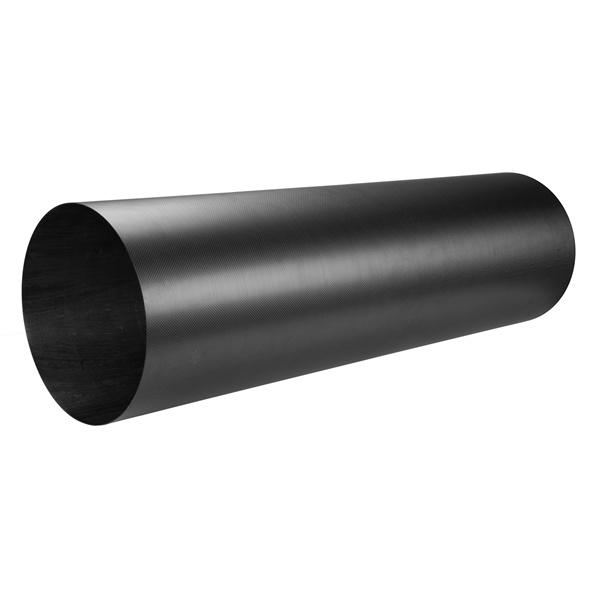

Xinbo Composites customizes large diameter carbon fiber tubes according to customers’ projects and chooses proper materials, tooling, and layer-up or angles to meet strength requirements and production process.
Material: Standard Modulus / Intermediate Modulus / High Modulus / Ultra High Modulus Carbon Fiber
Patterns: UD, Twill or Plain
Max Diameters Range: up to 500 mm
Wall Thickness: 0.6 - 50 mm
Max Lengths: Up to 6000 mm
OD Tolerances: Raw Tubing: ±0.1mm
Polished Tubing: ±0.02mm ~ ±0.05mm, Painted Tubing: ±0.10mm
Surface Finish: Raw, Polished, Glossy & Matte Clear Coated
CNC Machining: Drilling, Cutting, Grinding, Slotting, Milling Holes
Assembly and Bonding: we use the strongest adhesive and bonding tubes with aluminum or plastic parts, and assemble them as customers' requirements.
Large diameter carbon fiber tubes are advanced composite structures designed for applications that require high stiffness, low weight, corrosion resistance, and excellent dimensional stability. Compared with metal tubes such as aluminum or steel, carbon fiber tubes offer a superior strength-to-weight ratio, making them ideal for aerospace, robotics, marine, automotive, industrial equipment, and high-end custom engineering projects.
Large diameter carbon fiber tube is a hollow composite tube made from carbon fiber reinforcement and resin. The tube can be manufactured using different processes, including roll wrapping, filament winding, pultrusion, or braiding.
The term “large diameter” usually refers to tubes with an outer diameter over 50mm, which are often used as structural components, protective housings, support frames, masts, ducts, robotic arms, and lightweight mechanical parts.
Depending on the application, large carbon fiber tubes can be produced with a variety of wall thicknesses, fiber orientations, surface finishes, and CNC machining options.
High stiffness with low weight: A larger diameter naturally improves bending stiffness, while carbon fiber keeps the total weight much lower than metal alternatives.
Excellent corrosion resistance: carbon fiber does not rust like steel and is suitable for humid, marine, outdoor, and chemically challenging environments.
Flexibility: Carbon fiber layup or angle can be adjusted to improve axial stiffness, bending strength, torsional resistance, impact performance, or surface appearance, which makes carbon fiber tubing highly customizable for demanding engineering projects.
Good fatigue resistance: Large diameter carbon fiber tubes also offer good fatigue resistance, which is useful for structures exposed to repeated loading, vibration, or long-term mechanical stress.
In aerospace and UAV systems, large diameter carbon fiber tubes can be used for frames, support arms, housings, and airframe structures.
In robotics and automation, large diameter carbon fiber tubes are suitable for lightweight robotic arms, industrial rollers, end-effectors, and high-speed moving structures where reduced inertia improves performance.
In marine and outdoor equipment, carbon fiber tubes are used for masts, poles, booms, and support structures. Their corrosion resistance makes them suitable for saltwater and humid environments.
In automotive and motorsport applications, large carbon fiber tubes can be used for intake systems, ducts, roll structures, reinforcement parts, and custom lightweight components.
Large diameter carbon fiber tubes are also used in camera equipment, inspection systems, antennas, industrial machinery, sports equipment, and custom composite assemblies.
1. Why use Carbon Fiber?
Carbon Fiber is a polymer and a very strong and lightweight material. Carbon fiber is five times stronger than steel and twice as stiff. Carbon fiber is usually about 35–45% lighter than aluminum, about 60% lighter than titanium, and about 75–80% lighter than steel.
Carbon fiber is widely used in high-performance products because it combines low weight, high strength, excellent stiffness, and strong design flexibility.
2. What are The Advantages Of Carbon Fiber?
Super Lightweight than metal tubing
High Strength
Anti-Corrosion
Low Thermal Expansion
Low Fiber Density
Good Fatigue Resistance
Multiple axial layups or angles can be designed to reach the best performance
3. How to customize carbon fiber products for projects?
We customize a wide range of carbon fiber products according to customers’ specifications, drawings and mechanical strength requirements. Our team also answers your questions and offers professional suggestions.
4. Which Style of Carbon Fiber Is Best?
We offer multiple grades of carbon fiber that are optimized for stiffness, strength and price. Standard modulus carbon fiber is most common and usually the most affordable. Intermediate modulus is the strongest available fiber and high modulus tubes are super stiff.
5. What’s the Difference Between Unidirectional and Weave Fabric?
Unidirectional carbon fiber is the structural backbone of all our tubes. The plain and twill fabric weave offers a ”carbon fiber appearance” is only the outside layer and helps with durability. Our tubes typically use multiple layers designed for optimal performance in a wide range of conditions.
6. What Composites or Materials Do You Use?
Prepregs: Standard, Medium, High and Ultra-high-modulus Carbon Fibers, E-Glass, S-Glass, and Kevlar
Connectors: Metals and Alloys, Including Aluminum, Stainless Steel, Cooper, Titanium Components, Nylon, Plastic Machining Parts
7. What Additional Services Do You Offer?
We offer polishing, CNC machining, coating, bonding & assembly optional services
8. How To Cut or Drill Holes?
We use CNC machining to cut, drill holes, and slot for tubes and plates.
9. What Tube Surface Finishes Do You Provide?
We supply carbon fiber tubes with surface finishes, eg raw, polished, painted, glossy, or matte.
10. What shipment terms do you offer?
Express – for sample order or urgent order ;
By air – better for goods weighing less than 100kg.
By sea – better for large volume or heavy goods.

Composites Expert for Customized Premium Carbon Fiber Products & Telescopic Pole Systems