
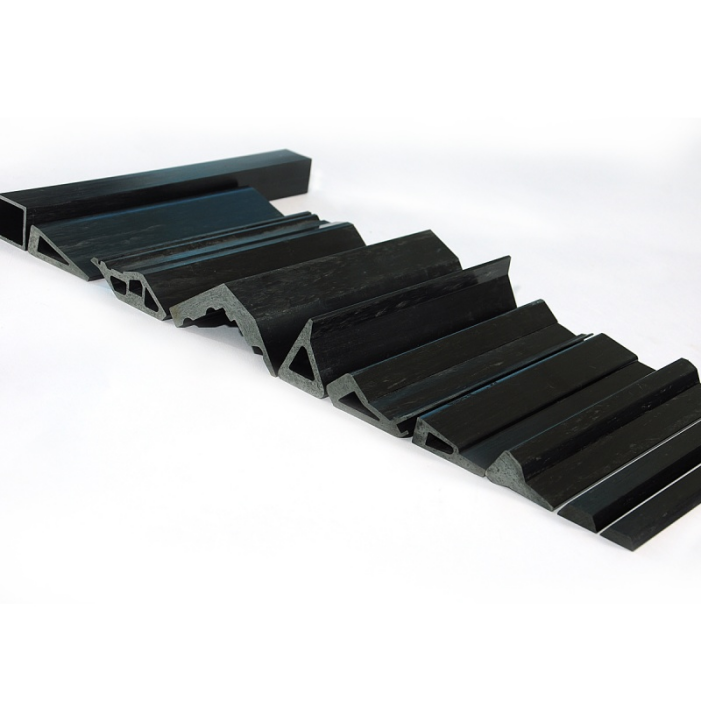
Carbon fiber structural beams offer an alternative lightweight to steel and aluminum profiles in applications where weight, stiffness, and dimensional stability matter. Their performance depends on cross-section geometry, fiber orientation, and load conditions. Replacing metal beams therefore requires evaluation structural rather than simply matching dimensions.
Xinbo Composites manufactures custom carbon fiber I-beams, angle profiles, C-channels, hat stiffeners, brackets, and other structural components based on OEM drawings.
Manufacturing Capabilities
Xinbo produces custom carbon fiber profiles using autoclave-cured prepreg layup. Fiber orientation and laminate thickness can be tailored to bending, tension, compression, and shear requirements.
Standard Modulus carbon fiber suits many structural applications, while Medium and High Modulus options provide greater stiffness where required. Available options include:
Profiles: I-beams, L-angles, C-channels, hat sections, and custom geometries.
Finishes: Matte, gloss, or unfinished surfaces.
Post-processing: CNC trimming, drilling, and dimensional finishing.
Prototypes and production orders are supported. Tolerances and lead times are confirmed after drawing review.
Carbon Fiber I-Beams vs. Angle Profiles
Carbon fiber I-beams use two flanges connected by a web to resist bending efficiently along a primary axis. They are suitable for lightweight cross-members, support rails, and equipment frames.
Important specifications include beam height, flange width, web and flange thickness, length, and structural load requirements.
Unlike predominantly axial-fiber pultruded profiles, custom prepreg layups allow additional fiber orientations to improve shear and torsional performance.
Carbon fiber angle profiles feature two legs, typically forming a 90-degree section. They are used for corner reinforcement, frame connections, and mounting structures.
Drawings should define leg dimensions, wall thickness, corner radius, length, and required hole locations.
Applications: Truss Structures and Brackets
Carbon fiber structural components are used in weight-sensitive and precision assemblies, including:
Robotics: Gantry cross-members and equipment frames.
UAVs and aerospace: Lightweight supports and structural reinforcement
Medical equipment: Support rails and positioning structures.
Industrial inspection: Sensor mounts and measurement frames.
Truss assemblies: Lightweight members for tension and compression loads.
Custom carbon fiber brackets and gussets can be combined with carbon fiber tubes and carbon fiber sheets and plates for larger assemblies.
Custom Carbon Fiber Profiles
For an accurate quotation, provide:
CAD drawings or PDF with specific dimensions and tolerances
Cross-section dimensions, wall thickness, and overall length.
Load, stiffness, or specified layup requirements.
Surface finish and machining details.
Prototype or production quantity.
If the laminate design is not finalized, Xinbo can review the performance requirements and recommend a suitable fiber configuration.
Request a quote with your drawings to discuss manufacturing, pricing, and lead times.
Frequently Asked Questions
Are carbon fiber beams always lighter and stiffer than aluminum beams?
Carbon fiber offers high specific stiffness, but actual beam stiffness depends on geometry, laminate design, and loading. Performance must be verified for each application.
Can Xinbo manufacture custom carbon fiber I-beams and angles?
Yes. Xinbo supports custom profiles with specified dimensions, laminate configurations, finishes, and machining requirements.
Can brackets, tubes, and structural beams be quoted together?
Yes. Customers can submit drawings and a bill of materials for multiple carbon fiber components in one quotation.