
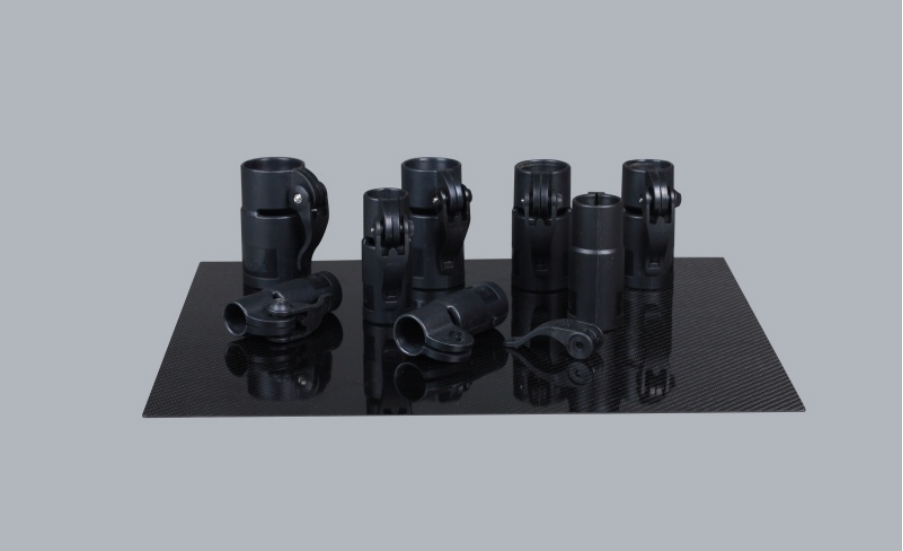
Choosing the right carbon fiber tube connectors is essential for building reliable structural assemblies. OEM manufacturers must consider tube diameter, wall thickness, joint loads, and whether the connection needs to be permanent or removable. Poor connector selection can cause tube damage, joint slippage, or premature failure.
Xinbo Composites manufactures carbon fiber tubes and provides integrated assembly solutions, including bonded inserts, mechanical clamps, sleeve joints, and telescoping systems. This guide explains the main connection methods and their applications.
Mechanical Carbon Fiber Tube Connectors
Mechanical connectors provide removable connections for carbon fiber tube assemblies. Common options include external clamps, internal inserts, and brackets designed for shaped profiles.
External clamps grip the tube’s outer diameter without drilling. They are suitable for adjustable frames and equipment requiring maintenance or disassembly. However, excessive tightening can damage thin tube walls. Clamp dimensions, contact area, and tightening torque must therefore match the tube specifications.
Internal inserts fit inside the tube bore and provide mounting interfaces such as threaded ends or flanges. Bonded inserts are generally preferred over interference fits when press-fitting could damage the composite wall.
For square or octagonal carbon fiber tubes, external brackets can engage flat surfaces to improve alignment and resist rotation. Connector selection should account for axial, bending, and torsional loads.
Carbon Fiber Joints Using Structural Adhesives
Adhesive bonding is widely used for permanent carbon fiber joints. Structural epoxy distributes loads across the bonded interface and avoids drilling holes that could weaken the laminate.
Bond strength depends on overlap length, adhesive properties, surface preparation, and loading conditions. Proper surface preparation typically involves cleaning and controlled abrasion without damaging the reinforcement fibers.
For carbon fiber-to-aluminum connections, designers must also consider differential thermal expansion and galvanic corrosion. Suitable adhesive systems and electrical isolation can help reduce these risks.
Xinbo provides bonded metal inserts and tube assemblies with threaded or flanged connection points. Each design should be evaluated against its intended operating loads.
Telescoping Clamps and Adjustable Tube Connectors
Telescoping connectors allow carbon fiber tubes to extend, retract, and lock at different lengths. They are commonly used in inspection poles, masts, and adjustable support structures.
Typical locking mechanisms include twist-lock and lever-lock clamps. These connectors must provide sufficient holding force without crushing or scratching the tube surface.
Key design considerations include tube diameter tolerances, overlap length, clamp pressure, and bending loads at maximum extension.
Xinbo supplies telescoping carbon fiber tube systems with integrated locking connectors. Matching tube dimensions and connector geometry helps achieve consistent adjustment and secure positioning.
Carbon Fiber Sleeve Connectors
A carbon fiber sleeve connector joins two tube sections along a common axis. External sleeves fit over the tube ends, while internal sleeves fit inside their bores. Both designs can use structural adhesive to create permanent joints.
Carbon fiber sleeves can reduce weight and may offer better thermal compatibility with carbon fiber tubes than metal alternatives. However, actual thermal expansion depends on fiber orientation and laminate construction.
Sleeve design must account for bonding length, dimensional tolerances, and expected axial, bending, and torsional loads.
For tapered carbon fiber tubes, the connector geometry must follow the local tube profile to maintain proper fit and bonding clearance.
Custom Carbon Fiber Tube Connector Assemblies
OEM customers should provide the following information when requesting customized assemblies:
Tube dimensions, cross-section, and wall thickness
Connector type, material, and required tolerances
Expected loads and operating environment
Bonding overlap or mechanical fastening requirements
Assembly drawings and surface finish specifications
Xinbo Composites supports tube manufacturing, connector integration, and assembly services, helping customers coordinate tube and connector specifications within one manufacturing process.
Frequently Asked Questions
What connectors work best for thin-walled carbon fiber tubes?
Bonded inserts and sleeve joints are often suitable because they distribute loads over a larger area. Mechanical clamps require carefully controlled contact pressure.
Can carbon fiber tubes be permanently joined with epoxy?
Yes. Structural epoxy can form reliable permanent joints when the adhesive, surface preparation, and joint geometry are properly designed.
When should carbon fiber sleeve connectors be used?
Sleeves are suitable for joining aligned tube sections, particularly when lightweight construction and compatible composite materials are priorities.
Does Xinbo provide assembled carbon fiber tube systems?
Yes. Xinbo offers bonded inserts, sleeve joints, mechanical clamp integration, and customized telescoping tube assemblies based on customer specifications.