
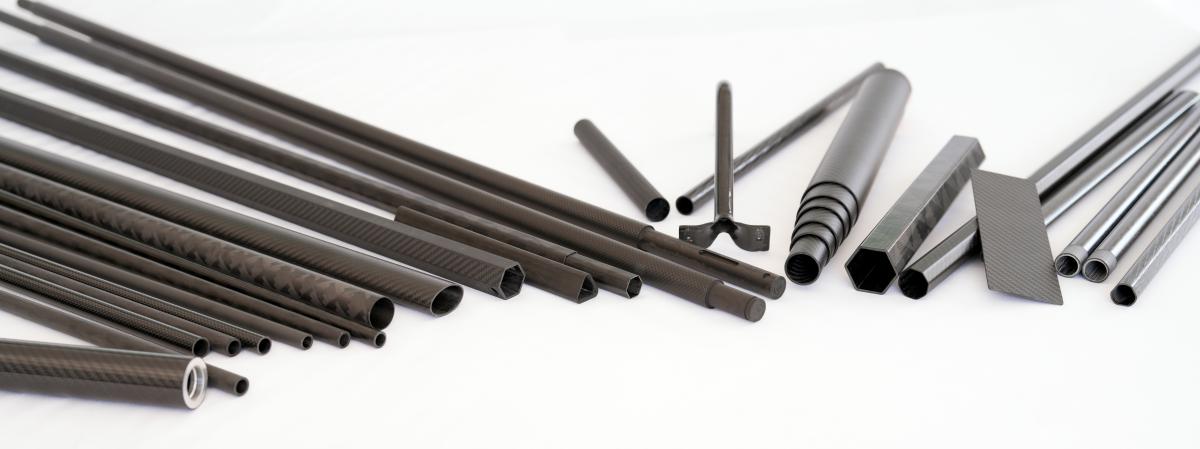
Aerospace structural applications demand more from a carbon fiber tube than most industrial uses. The load cases are more complex: torsion, bending, and combined loads operating simultaneously. The tolerances are tighter. The drawings arrive with winding angles or lay-up, modulus requirements, and OD tolerance classes already specified.
Xinbo’s ISO 9001-certified factory in Weihai manufactures custom aerospace carbon fiber tubes up to 500mm OD, across SM, IM, HM, and UHM fiber grades. Carbon fiber tubes are built from drawings: OD tolerance, fiber grade, surface finish, and any CNC or assembly requirements are confirmed before production.
Which Aerospace Applications Do Engineers Specify Structural Carbon Fiber Tubes For?
Aerospace engineers specify structural carbon fiber tubes where the weight-to-stiffness ratio of the finished assembly is a primary design constraint. In airframe structural tubes, the combination of IM or HM fiber grade with a polished OD tolerance of ±0.05mm allows tight assembly fits without secondary machining. Defense communication masts require large-diameter filament-wound tubes, often multi-section and collapsible, where the winding angle is critical to torsional performance under deployment loads. Payload and instrument bay tubes are among the most tolerance-critical applications in the category, with OD specifications often driven by the bore size of the housing rather than the structural load requirement alone. Ground support equipment tubes cover a wide OD range and are typically specified in SM or IM grade where weight reduction matters but the stiffness requirement is less demanding than primary flight structures.
| Application | Tube Type | OD Range | Fiber Grade | Key Requirement |
|---|---|---|---|---|
| Airframe structural tubes | Roll-wrapped / filament wound | 30–150mm | IM / HM | OD tolerance ±0.05mm |
| Defence communication masts | Filament wound | 40–200mm | SM / IM | Multi-section, collapsible |
| Aerospace structural spars | Roll-wrapped | 15–50mm | IM / HM | Per customer drawing |
| Ground support equipment tubes | Roll-wrapped | 20–100mm | SM / IM | Lightweight, high load capacity |
| Instrument bay tubes | Roll-wrapped / filament wound | 20–200mm | IM / HM | Tight OD tolerance per drawing |
Xinbo Composites customizes a range of carbon fiber tubes and custom carbon fiber parts for aerospace applications
Which Manufacturing Process Suits Aerospace Structural Carbon Fiber Tubes?
The choice between filament winding and roll-wrapping is decided by the primary load case on the customer’s drawing. Filament winding is specified when the tube carries torsion or combined torsion and bending loads; the winding angle is programmed per the drawing and directly controls how the tube behaves under its operating load. Tubes up to 500mm OD are achievable through filament winding, making it the preferred process for large-diameter defense masts and structural columns where torsional stiffness is the governing design criterion.
Roll-wrapping uses pre-cut prepreg plies at fixed orientations, which gives tighter control over OD tolerance, polished to ±0.02mm for applications where assembly fit is critical. It is the preferred process for aerospace structural spars, instrument bay tubes, and smaller-diameter airframe components where axial bending governs and dimensional repeatability across a production batch matters as much as structural performance. When the drawing specifies both a tight OD tolerance and a non-standard layup sequence, the engineering team will confirm the correct process before production begins.
| Process | Best For | Max Length | Capability |
|---|---|---|---|
| Filament winding | Torsion and combined load structures | Up to 15m | Custom winding angles, high torque |
| Roll-wrapping | Axial bending, tight OD tolerance | Up to 6m | High performance, straightness, lightweight, |
See Xinbo’s filament wound carbon fiber tubes product page and roll-wrapped carbon fiber tube manufacturing guide for process details and standard specifications.
What Fiber Grade and OD Tolerances Are Available for Aerospace Carbon Fiber Tubes?
Fiber grade selection determines the stiffness-to-weight performance of the finished aerospace tube. For most structural aerospace applications, the decision falls between Intermediate Modulus (IM) and High Modulus (HM). IM delivers a well-established balance of stiffness, strength, and compatibility with standard epoxy systems. HM is specified where maximum stiffness per gram is the design driver and the application tolerates the higher material cost. Standard Modulus (SM) remains appropriate for ground support and non-primary structural applications where dimensional stability matters more than minimum weight. Ultra-High Modulus (UHM) is reserved for specialist applications where extreme stiffness requirements and tight mass budgets coincide, typically specified with exact modulus values on the drawing.
OD tolerance class is driven by the assembly interface requirement. Tubes that slip-fit into housings or connect to precision-machined interfaces are polished to ±0.02–0.05mm. Structural tubes with bonded joints or clearance fits use raw or standard polished tolerance classes.
| Fiber Grade | Typical Aerospace Application | OD Tolerance |
|---|---|---|
| Standard Modulus (SM) | Ground support, structural pole systems | ±0.15mm raw±0.05mm for polished, ±0.1mm for coating |
| Intermediate Modulus (IM) | Airframe structural tubes, structural spars | ±0.15mm raw±0.05mm for polished, ±0.1mm for coating |
| High Modulus (HM) | Precision structural tubes, high-stiffness applications | ±0.15mm raw±0.05mm for polished, ±0.1mm for coating |
| Ultra-High Modulus (UHM) | High-stiffness structural and defense applications | ±0.15mm raw±0.05mm for polished, ±0.1mm for coating |
What to Include on Your Drawing to Order Aerospace Carbon Fiber Tubes
Production starts from the customer’s drawing, not a catalog selection. A complete drawing allows the engineering team to confirm tooling requirements, select the correct mandrel, program the winding angle, and return a production-ready quote in one round. Incomplete drawings lead to additional back-and-forth that extends the pre-production timeline. The following fields are required on the drawing to proceed to quotation:
- ID, OD, Length, Thickness (mm) : sets the mandrel size, CNC processing
- Fiber grade : SM / IM / HM / UHM
- Layup or winding angle : controls structural performance for the load case
- Surface finish : raw/polished/glossy / matte clear-coated
- CNC machining requirements : drilling, slotting, cutting, grinding, milling
- Assembly requirements : bonding with aluminum or plastic fittings
If winding angle or layup is not specified on the drawing, the engineering team will recommend the appropriate angle based on the application and confirm before production begins.
FAQ
What is the maximum OD and length available for aerospace carbon fiber tubes?
Filament wound aerospace carbon fiber tubes are available up to 500mm OD and 15m in length; roll-wrapped tubes are available up to 500mm OD and 6m in length.
Which fiber grade suits structural aerospace carbon fiber tube applications?
Intermediate Modulus (IM) and High Modulus (HM) grades are most commonly specified for aerospace structural tubes. The correct grade is confirmed from the customer’s drawing before production begins.
What OD tolerance is achievable on aerospace carbon fiber tubes?
Polished aerospace carbon fiber tubes are held to ±0.05mm OD tolerance, with precision-polished tubes reaching ±0.02–0.05mm depending on OD and wall thickness.
Are CNC machining and assembly available on aerospace carbon fiber tube orders?
Yes. CNC machining (drilling, slotting, cutting, milling, grinding) and assembly bonding with aluminum or plastic fittings are available as standard add-on services.
Request a Custom Aerospace Carbon Fiber Tube
Xinbo’s ISO 9001-certified factory supplies aerospace carbon fiber tubes to OEM manufacturers in 100+ countries. Send your drawing to request a quote.