
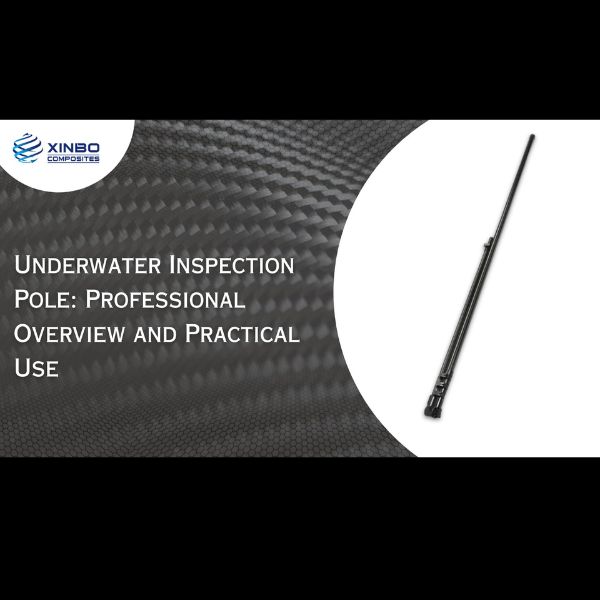
An underwater inspection pole is a specialized tool designed to provide clear, real-time visuals beneath the water’s surface, allowing users to inspect, monitor, and document underwater environments without the need for diving. This equipment is widely used across marine, industrial, environmental, and rescue applications due to its practicality, safety, and efficiency.
What Is a Carbon Fiber Underwater Inspection Pole Used For?
An underwater inspection pole consists of a long, extendable pole, commonly made from lightweight, durable materials such as carbon fiber, with a waterproof camera attached at the end. The camera transmits live video to a monitor or mobile device, enabling users to observe underwater conditions while remaining safely above the surface1.

Typical Specifications:
- Material: Carbon Fiber
• Extended Length: 7.6 meters (custom lengths available)
• Contracted Length: 2.0 meters
• Sections: 6 telescopic segments
• Clamps: Quick-release style for efficient adjustment
• Weight: Approximately 1850g
• Camera: IP68 waterproof rating
• Monitor: 7-inch display with built-in battery
• Cable: 15 meters, providing flexible reach
• Mount: 1/4″-20 camera mount for secure attachment
How Does It Work?
Using an underwater inspection pole is straightforward:
• Attach the waterproof camera securely to the pole’s end.
• Extend the pole to the desired length using the telescopic sections and quick-release clamps.
• Lower the camera into the water, guiding it to the area that needs inspection.
• View the live video feed on the included monitor, which is powered by a built-in battery.
• Move the pole as needed to inspect different angles or locations.
• Record video or capture images for documentation and later review if required.
Key Applications
Marine and Boating:
Boat owners use inspection poles to check for damage, fouling, or entanglements beneath hulls and around propellers, eliminating the need for costly and potentially hazardous diving.
Rescue and Emergency Services:
Rescue teams deploy these poles to search for people or objects in rivers and lakes, especially where water conditions are dangerous or visibility is poor. The camera’s built-in lights assist in low-visibility environments.
Aquaculture and Fisheries:
Fish farmers utilize inspection poles to monitor fish health, inspect nets for holes, and assess tank conditions, all without disturbing the aquatic environment.
Engineering and Infrastructure:
Engineers and maintenance teams use inspection poles to examine underwater structures such as bridges, dams, and pipelines, enabling routine checks and early detection of issues.
Environmental Monitoring:
Scientists and researchers rely on these tools to study aquatic plants, animals, and habitats, capturing video and images for further analysis without disrupting the ecosystem.
Advantages
- Enhanced Safety: Inspections can be performed from above the water, reducing the risks associated with diving.
• Efficiency: Quick setup and real-time visuals allow for faster assessments and decision-making.
• Versatility: Suitable for a wide range of underwater inspection tasks across different industries.
• Portability: Lightweight construction and compact design make transport and deployment straightforward.
• Documentation: The ability to record video and capture images supports reporting and analysis.
Considerations for Selection
When choosing an underwater inspection pole, consider the following:
- Length: Select a pole with sufficient reach for your typical inspection depth.
• Material: Carbon fiber offers a strong, lightweight, and corrosion-resistant option.
• Camera Quality: High-definition video and reliable waterproofing (IP68 rating) are essential for clear imaging.
• Lighting: Built-in lights on the camera help in dark or murky water.
• Monitor: Ensure the display is large enough for clear viewing and has adequate battery life for your needs.
• Portability: Choose a system that is easy to transport and set up, especially if inspections are conducted in remote locations.
Maintenance and Best Practices

- Rinse all components with fresh water after use, especially following exposure to saltwater, to prevent corrosion.
• Inspect seals, connectors, and clamps regularly for signs of wear or damage.
• Store the pole and camera system in a dry, protective case when not in use.
• Charge all batteries fully before field operations and carry spares if extended use is anticipated.
Common Questions
How deep can an underwater inspection pole reach?
Most professional poles extend between 4 and 10 meters, with some models reaching up to 18 meters. Always verify both the pole’s length and the camera’s waterproof rating before use.
Can it be used in saltwater?
Yes, provided both the pole and camera are rated for saltwater use. Rinse thoroughly with fresh water after each use to prolong equipment life.
Is it difficult to operate?
Most systems are designed for ease of use, with intuitive controls and quick-release clamps for fast setup and adjustment.
Can videos and images be recorded?
Yes, most inspection pole systems allow for video recording and still image capture, supporting documentation, and later analysis.
Conclusion: Why Professionals Choose Xinbo’s Underwater Inspection Poles
Underwater inspection poles offer a practical, efficient, and safe solution for observing and documenting underwater environments. Their robust construction, ease of use, and adaptability make them valuable tools for professionals in marine, rescue, aquaculture, engineering, and environmental fields. By selecting the right specifications and maintaining the equipment properly, users can ensure reliable performance and clear results for a wide range of underwater inspection tasks only at Xinbo Composite.
Xinbo Composites delivers a comprehensive portfolio of carbon fiber and composite solutions, including underwater inspection poles, telescopic systems, precision-engineered tubes, sheets, custom parts, and advanced components, serving the diverse and evolving needs of industrial, marine, infrastructure, automation, sporting, and high-performance sectors