
Xinbo Composites is a professional manufacturer of carbon fiber tubes. We have several different production technologies for carbon fiber tubes, each tailored to achieve specific properties such as strength, stiffness, and weight.
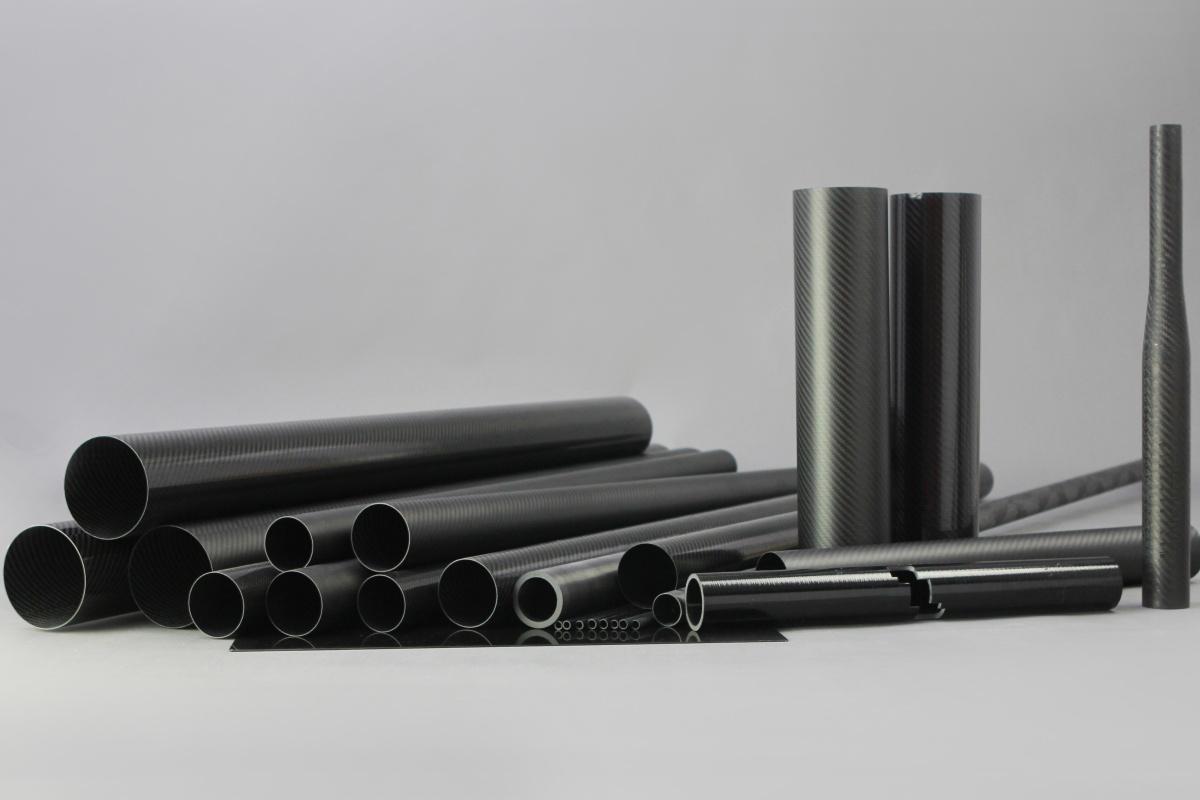
Pultrusion: This method involves pulling carbon fibers through a resin bath and then through a heated die to cure and shape the tube. It’s efficient for producing long lengths of constant cross-section tubes, offering high tensile. Pultrusion is the cost-effective process to produce round and shaped tubes.
Filament Winding: In this process, continuous carbon fibers are wound around a rotating mandrel at specific angles. Resin is either pre-impregnated into the fibers or applied during the winding process. The tube is then cured, often in an oven, to solidify the shapes. The filament winding process is ideal for making tubes with high strength and stiffness in the circumferential direction.
Roll Wrapping: Roll wrapping involves wrapping prepregs carbon fiber around a mandrel in layers. The orientation of the fibers can be varied with each layer to optimize strength and stiffness. After wrapping, the tube is cured in an oven or autoclave.
Autoclave Molding: Similar to roll wrapping, this process uses sheets of carbon fiber pre-impregnated with resin. The sheets are laid up by hand or machine onto a mold in specific orientations, then cured under heat and pressure, often in an autoclave. Autoclave Molding provides good control over fiber orientation and thickness, is suitable for square, rectangular, hexagonal, octagonal, oval, and other shaped tubes, and provides the best strength.
Each of these process technologies can be adjusted and combined to meet specific requirements for performance, weight, and cost. The choice of production method depends on the desired properties of the final product, including strength, stiffness, weight, and the complexity of the tube’s shape.