

Xinbo Composites specializes in customizing lightweight and high-precision carbon fiber robotic arms for industrial automation.
Industrial robotic arms utilizing carbon fiber composites offer significant advantages over traditional aluminum or steel systems, primarily due to their extreme stiffness-to-weight ratio. In industrial automation, this translates directly to reduced cycle times, higher precision, and lower energy consumption.
Industrial Carbon Fiber Robotic Arms’ Advantages
1. High Power-to-Weight Ratio
The most immediate benefit is the reduction in dead weight. Because carbon fiber is significantly lighter than metal, the motor and actuators do not have to work as hard to move the arm itself.
Increased Payload: By reducing the mass of the arm, the robot can carry heavier loads without upgrading to larger, more expensive motors.
Lower Energy Consumption: Smaller masses require less torque to move, leading to lower energy costs and less wear on mechanical components.
2. Dynamic Performance and Speed
In industrial automation, throughput is everything. Carbon fiber’s low inertia allows for much higher acceleration and deceleration rates.
Faster Cycle Times: The arm can start and stop almost instantly, reducing the time spent per task.
Reduced Vibration (Damping): Carbon fiber has excellent internal damping characteristics. Unlike metal arms that may “ring” or vibrate after a sudden stop, carbon fiber settles almost immediately, allowing for faster high-precision movements.
3. High Rigidity and Precision
Precision in robotics depends on the modulus of elasticity. Carbon fiber is incredibly stiff, which minimizes “deflection” or bending when the arm is fully extended or carrying a load.
Repeatability: Lower deflection ensures that the end-effector (the tool at the tip) hits the same coordinates every time, even at high speeds.
Long-Reach Stability: For arms exceeding 2 or 3 meters, metal becomes prohibitively heavy or prone to sagging. Carbon fiber maintains its shape over long spans.
4. Thermal Stability
Metals expand and contract significantly with temperature changes, which can throw off a robot’s calibration in a factory setting.
Low Coefficient of Thermal Expansion (CTE): Carbon fiber is dimensionally stable. Whether the factory is cold at startup or hot after hours of operation, the arm’s length and geometry remain virtually unchanged.
5. Fatigue Resistance
Robotic arms undergo millions of cycles of stress. While metals like aluminum have a “fatigue limit” and will eventually develop microscopic cracks, carbon fiber is exceptionally resistant to cyclic fatigue.
Longevity: A carbon fiber arm is less likely to suffer from structural failure over years of high-speed operation.
Carbon Fiber Robotic Arms Applications
The adoption of carbon fiber in robotics has expanded from niche high-end tech to several core industrial and scientific sectors. Its application is most prominent where speed, precision, and a “gentle” touch are required simultaneously.
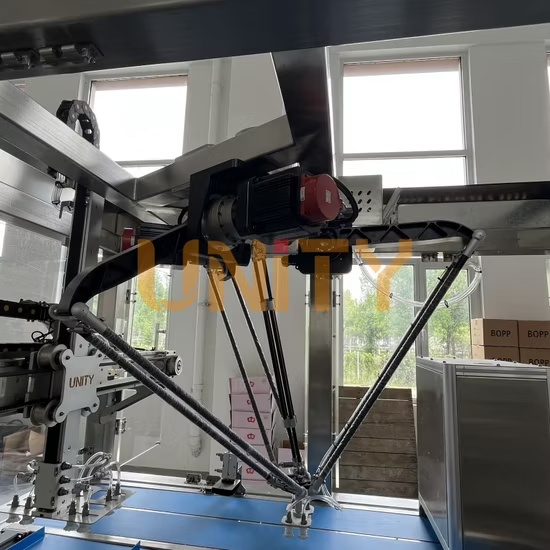
Carbon fiber delta robot arms are specifically engineered for high-speed, high-precision industrial automation. By replacing traditional aluminum rods with carbon fiber composites, manufacturers can achieve peak accelerations of up to 15 Gs and cycle times as low as 0.3 seconds.
Carbon Fiber Robot Fork (Carbon Fiber Rectangular Tube) for handling liquid crystal glass substrates. Carbon fiber composites are increasingly becoming the standard for high-speed industrial handling and heavy-payload automation. By reducing the dead weight of the robot arm, manufacturers can significantly increase payload capacity, acceleration, and positioning accuracy

If you want to develop carbon fiber robotic arms, please contact us for a quote.