
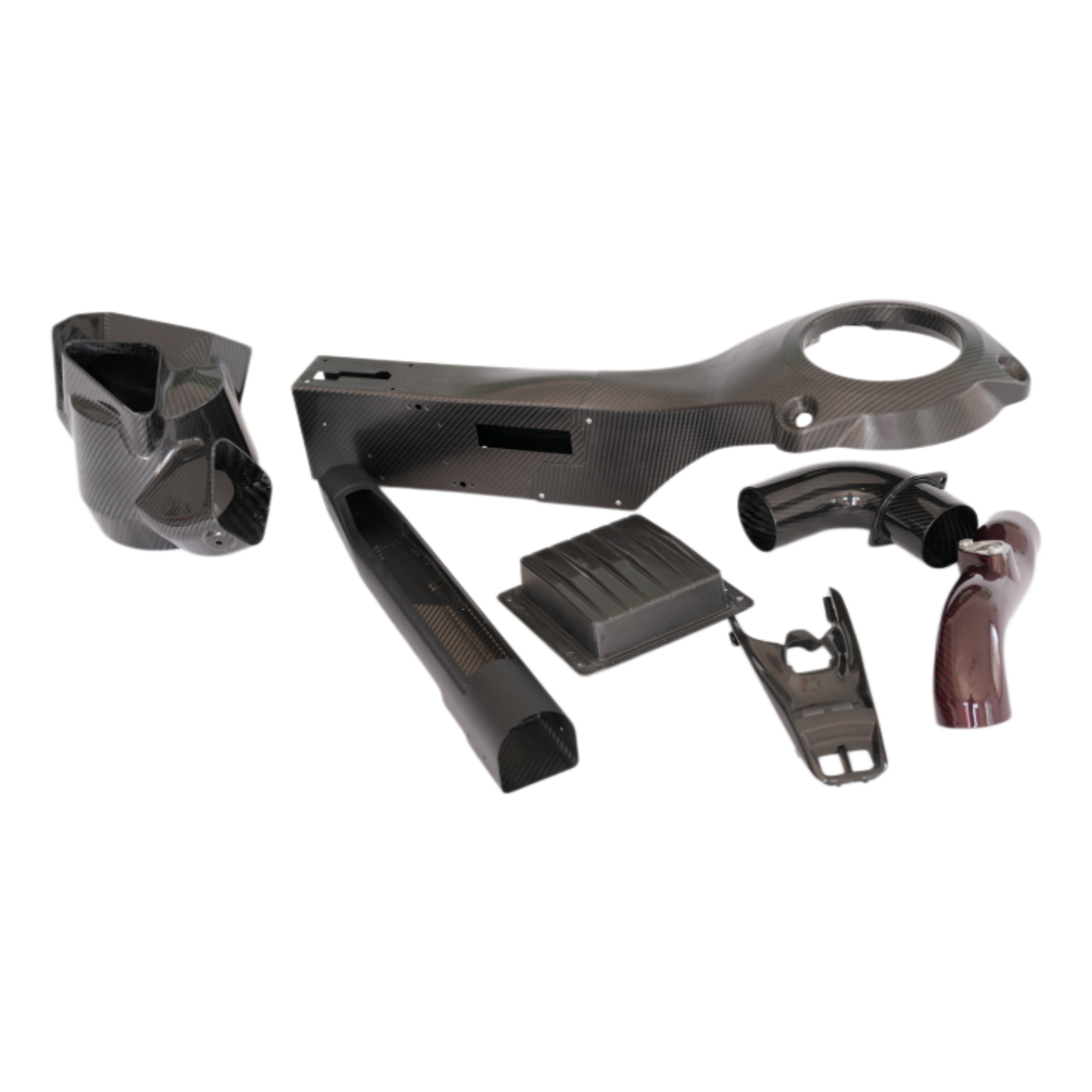
Custom carbon fiber parts are widely used in industries that require lightweight strength, high stiffness, corrosion resistance, and a premium appearance. From automotive components and drone frames to robotics parts, marine panels, camera equipment, sports accessories, and industrial structures, carbon fiber offers performance advantages that traditional materials often cannot match.
This guide explains what custom carbon fiber parts are, how they are made, where they are used, and what factors should be considered before starting a custom carbon fiber parts project.
What Are Custom Carbon Fiber Parts?
Custom carbon fiber parts are components manufactured from carbon fiber reinforced polymer composites. Carbon fiber fabric, unidirectional carbon fiber, or prepreg carbon fiber is combined with resin to create a strong and lightweight structure.
Unlike standard carbon fiber sheets, tubes, or plates, custom carbon fiber parts are designed according to specific drawings, dimensions, performance requirements, and surface preferences. They can be made as flat panels, curved shells, molded parts, brackets, covers, tubes, arms, housings, decorative trim, or structural components.
The biggest value of customization is that the part can be engineered for its actual use. Thickness, fiber direction, layup structure, surface finish, mounting holes, inserts, edge treatment, and tolerance can all be adjusted based on the final application.
Why Choose Carbon Fiber for Custom Parts?
Carbon fiber is known for its excellent strength-to-weight ratio. It can be much lighter than steel or aluminum while still providing strong mechanical performance. This makes it ideal for applications where weight reduction is important.
Another key advantage is stiffness. A well-designed carbon fiber part can resist bending and deformation, helping improve stability, precision, and durability. This is especially useful in drones, robotics, racing vehicles, automation equipment, and camera support systems.
Carbon fiber also offers good corrosion resistance. Unlike steel, it does not rust, making it suitable for outdoor, marine, humid, and industrial environments when properly finished.
Appearance is another reason many customers choose carbon fiber. Glossy twill weave, matte plain weave, forged carbon, and unidirectional finishes all provide a modern and high-end look. For consumer products and performance parts, carbon fiber can improve both function and visual value.
Carbon Fiber Parts Manufacturing Process
Different carbon fiber parts require different manufacturing processes. The right method depends on part shape, quantity, strength requirement, surface quality, budget, and tolerance.
Autoclave molding eliminates bubbles and pinholes during the manufacturing process. It gives a perfect finish to enhance its cosmic appearance.
Autoclave molding is used to manufacture automotive components. Applying controlled heat and pressure allows manufacturers to produce incredibly strong, lightweight components such as automotive interior and exterior parts, intake and exhaust pipe systems, and energy machine parts. This improves fuel efficiency, reduces emissions and enables more aerodynamic designs
Compress Molding: Well-suited for producing high-volume, high-strength, and complex parts from composite materials. This process involves placing a material, often preheated, into an open, heated mold cavity, then closing the mold and applying pressure to force the material into the shape of the mold. As the material cures or cools, it solidifies into the final part shape.
Custom Carbon Fiber Parts Factors
Before manufacturing a custom carbon fiber part, the design should clearly define its function and working conditions.
The first factor is load direction. Carbon fiber performs best when the fiber orientation matches the direction of force. For structural parts, layup design is critical. A part can be made stronger in one direction or balanced for multi-directional loads.
The second factor is thickness. Thicker parts are usually stiffer, but they also add weight and cost. The goal is to find the right balance between strength, stiffness, and weight.
The third factor is mounting design. Holes, inserts, bolts, clamps, and bonding areas should be carefully designed because stress concentration around mounting points can affect durability.
Edge treatment is also important. Carbon fiber edges should be cleanly cut and sealed when necessary. Chamfering or rounding the edges can improve handling safety and appearance.
Surface finish should be selected based on the product’s purpose. Glossy finishes are suitable for premium visual parts, while matte finishes reduce reflections and create a technical appearance. For outdoor use, UV-resistant coating can improve long-term durability.
Information Needed for Custom Carbon Fiber Manufacturing
To produce accurate custom carbon fiber parts, customers usually need to provide clear technical information.
A CAD file is highly recommended. DXF, DWG, STEP, IGES, or 3D model files help define the exact shape and dimensions. For simpler parts, detailed drawings with length, width, thickness, hole positions, and tolerances may be enough.
The manufacturer also needs to know the application, load requirements, surface finish, quantity, tolerance, and whether the part is decorative or structural.
For molded carbon fiber parts, mold design is an important part of the project. The cost and lead time are usually higher than flat CNC-machined parts, but the result can be much better for complex shapes.
Common Applications of Custom Carbon Fiber Parts
Custom carbon fiber parts are used across many industries.
In automotive and motorsport, they are used for body panels, spoilers, interior trim, dashboards, underbody panels, brackets, and aerodynamic components.
In drones and UAVs, carbon fiber is used for drone frames, arms, landing gear, camera mounts, battery plates, and structural plates.
In robotics and automation, carbon fiber parts help reduce moving mass, improve speed, and maintain positioning accuracy.
In marine applications, carbon fiber is used for panels, covers, poles, masts, and reinforcement parts because of its lightweight and corrosion-resistant properties.
In photography and filming equipment, carbon fiber is used for camera masts, tripod parts, stabilizer arms, boom poles, and support structures.
In consumer products, carbon fiber is used for cases, covers, luxury accessories, sports goods, and custom decorative parts.
How to Choose a Custom Carbon Fiber Parts Supplier
A good supplier should understand both carbon fiber materials and real manufacturing requirements. The supplier should be able to review drawings, suggest suitable layup structures, recommend the right process, and explain what is realistic in terms of tolerance, finish, strength, and cost.
For structural parts, it is important to work with a supplier that can consider load direction, fiber orientation, thickness, bonding, and mounting points. For appearance parts, surface quality, weave alignment, coating, and trimming quality are more important.
Clear communication is essential. The more accurate the drawings and application details, the better the final part will match the design requirements.
Custom carbon fiber parts provide an excellent solution for projects that require lightweight strength, stiffness, corrosion resistance, and a premium appearance. They can be designed as flat plates, tubes, molded parts, sandwich panels, decorative covers, or structural components.
By choosing the right material, layup, manufacturing process, surface finish, and supplier, carbon fiber parts can deliver strong performance in automotive, aerospace, drone, robotics, marine, industrial, photography, and consumer product applications.
For businesses and engineers looking to improve product performance while reducing weight, custom carbon fiber parts are a practical and high-value material choice.